Abstract
The use of Geographic Information Systems (GIS) and Multi Criteria Decision Analysis (MCDA) techniques for the selection of suitable areas to the installation of wind farms has been reported by number of authors [ZHU] and researchers.
It is not however easy to reproduce the proposed approaches to other contexts with different data. This is the angle this article covers describing in practical terms the workflow of tasks to analyse and to select potential wind farm locations in the French department of “Loire Atlantique”, using open data and open-source tools (QGIS)
Introduction
The energy produced by wind turbines contributes along other renewable sources of energy to reach the objectives of CO2 reduction and climate balance. However, the location of new wind farms sites may be a sensitive subject.
The decision of the location of these sources of energy is critical regarding the energy production gains, costs and the risks of environmental impacts.
A simple search on the Internet of the combined use of GIS, MCDA and wind farms returns many results and research references. Some of them are sources of inspiration for this study. In particular, the article published by Ujaval Gandhi in the QGIS tutorials[1] site is the basis of the multi-criteria overlapping analysis. This approach has been enriched in this case with the Analytic Hierarchy Process (AHP) introduced by Saaty, and on the Weighted linear combination (WLC) technique to take into consideration the relative weight of each criterion.
The theoretical goal of this study case is the selection and prioritization of areas for the location of new wind farms in the French department of Loire-Atlantique of the Pays de la Loire region. The proposed methodology can be applied to other French departments or to other countries with some adaptations depending on the availability of data.
The vector and raster geo-processing tools as well as MCDA techniques were applied in this case to identify the areas per commune more suitable for the installation of new wind farms, considering the selected set of criteria and hypothesis.
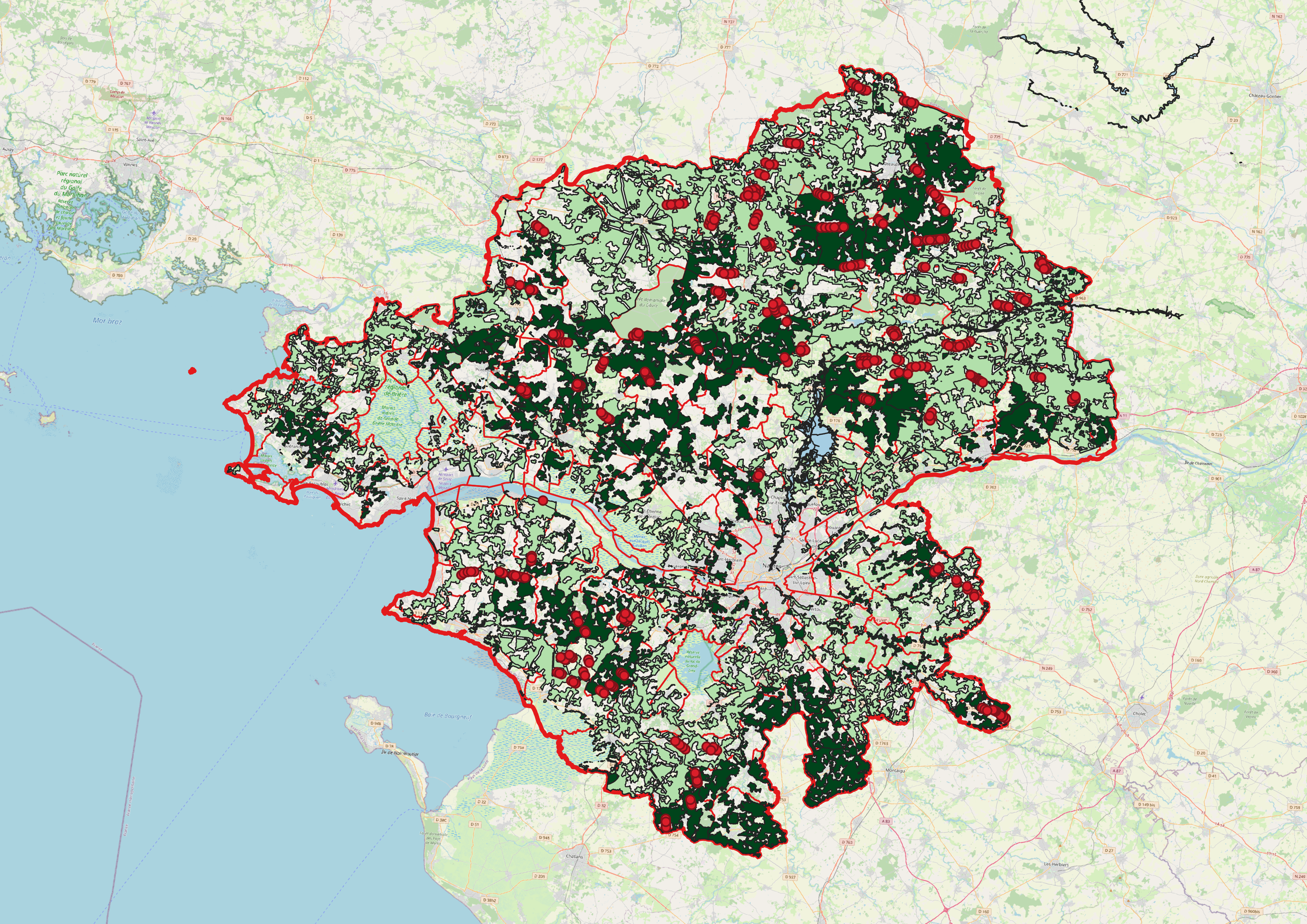
Finally, the results were compared with the position of the existing wind turbines in the department.
[1]https://www.qgistutorials.com/en/docs/3/multi_criteria_overlay.html
Methodology
The table below summarizes the proposed criteria, data sources and conditions.
| Criteria | Conditions | |
| W | Wind speed | W > 7 m/s (source: Global Wind Atlas) |
| S | Slope | Slope < 10 % (source: IGN BDALTI) |
| E | Proximity to transmission lines | 0,25 Km < E < 5Km (source: RTE) |
| R | Proximity to main roads | 0,15 Km < R < 5km (source: IGN Route500) |
| H | Distance to main water bodies | 0,10 km < H (source: IGN BDTOPO 2021) |
| L | Protected areas, flood areas, urban areas, … | Not in incompatible areas Source Nature 2000 and Corine Land Cover |
Depending on the availability and quality of the open data required for the analysis, additional criteria may be considered. This is particularly critical if the selected areas may represent a threat to animal species, such as migratory birds.
The multi-criteria overlapping analysis is based on the article published by Ujaval Gandhi in the QGIS tutorials site (https://www.qgistutorials.com/en/docs/3/multi_criteria_overlay.html).
The initial vector data (transmission, lines, routes, water bodies, protected areas) were geo-processed, rasterized and reclassified with the QGIS tools. All the resulting raster files were finally merged into one unique overlapping raster using the QGIS Raster Calculator tool.
As all the criteria raster shared the same characteristics: resolution, extent, CRS and range value (0-4), the resulting pixel value is obtained by the addition of the all the intervening raster files (criteria) multiplied by their relative weights estimated with the AHP method. Additional raster masks (department and protected areas) were used to discard areas outside the department and sensitive zones from Natura 2000.
For the MCDA part of the analysis, the methodology applied by Al-Shabeb et al[1] to the wind farms’ case in Jordan combining AHP and WLC, was used.
[1] Al-Shabeeb, A.R., Al-Adamat, R. and Mashagbah, A. (2016). AHP with GIS for a Preliminary Site Selection of Wind Turbines in the North-west of Jordan. International Journal of Geosciences, 7, 1208-1221.
This approach is based on the Analytic Hierarchy Process (AHP) approach introduced by Saaty, and on the Weighted linear combination (WLC) technique. The WLC calculation has been implemented in QGIS. AHP calculation is implemented using Python libraries.
“The Analytic Hierarchy Process (AHP) is a general theory of measurement. It is used to derive ratio scales from both discrete and continuous paired comparisons.” [SAATY][1]
The relative weights of predefined criteria have been estimated following the Analytic Hierarchy Process (AHP) approach and its fundamental scale.

Wind Farms location AHP Matrix
| Criteria | Wind | Slope | Electricity | Roads | Hydro | Land | |
| W | Wind | 1 | 1 | 3 | 3 | 3 | 2 |
| S | Slope | 1 | 1 | 1/3 | 3 | 1/3 | 1/5 |
| E | Electricity | 1/3 | 3 | 1 | 3 | 1/2 | 1/5 |
| R | Roads | 1/3 | 1/3 | 1/3 | 1 | 1/2 | 1/5 |
| H | Hydrography | 1/3 | 3 | 2 | 2 | 1 | 1/3 |
| L | Land Use | 1/2 | 5 | 5 | 5 | 3 | 1 |
The comparative paired values of the above table have been defined in an exploratory way. The number of criteria has been limited to 5 (Wind, Slope, Energy, Roads, Land Use).
Principal vector of relative weights has been calculated using the python library (numpy)
| W | S | E | R | L |
| 0.31 | 0.12 | 0.15 | 0.06 | 0.36 |
[1] See SAATY for a detailed description of the AHP approach.
Using the WLC technique, a rate from 1 to 4 will be assigned to each criterion cell (raster layer) depending on the following values table.
WLC – table
| Criteria | Rating | 1 | 2 | 3 | 4 | |
| C1 | Wind | Wind speed (m/s) | [4.5, 5] | ]5,6] | ]6,8] | ]8,M[ |
| C2 | Slope | Slope (%) | [10,7.5] | ]7.5,5] | ]5,2.5] | ]2,5,0] |
| C3 | Electricity | Proximity to transmission lines (m) | [5000,4000] | ]4000,3000] | ]3000,2000] | ]2000,250] |
| C4 | Roads | Proximity to main roads (m) | [5000,4000] | ]4000,3000] | ]3000,2000] | ]2000,250] |
| C5 | Hydrography | Distance to main water bodies (m) | [100,500] | ]500,750] | ]750,1500] | ]1500,M[ |
| C6 | Land Use | Not in incompatible areas (protected areas, flood areas, urban areas, …) | 321_Natural grasslands(1) | 322_Moors and heathland | 211_Non-irrigated arable land | 231_Pasture, meadows, and other permanent grassland under agriculture |
The figure below shows the raster files representing each criterion.
Criteria Analysis aand Workflow
| Wind | Slope | RTE | Route | Land Use | MCDA |
 |  |  |  |  |  |
The total weight of each pixel will be computed using the following expression in the Raster Calculator tool.
Si = ∑ Ci Wi
Wind Farm’s candidate municipalities
The table below lists the top 10 municipalities with higher suitable areas for the installation of wind farms in the department of Pays de la Loire.
| Top 10 municipalities for Wind Farms sites | Suitable areas in the Blain’s municipality |
 |  |

References
[ZHU] Zhu, Xuan. GIS for Environmental Applications. Taylor and Francis. Édition du Kindle.
[DIAZ-CUEVAS] Pilar Diaz-Cuevas, Brahim Haddad, Miriam Fernandez-Nuñez, “Energy for the future: Planning and mapping renewable energy. The Case of Algeria” (2020), Elsevier (www.elsevier.com/locate/seta ),ScienceDirect, Sustainable Energy Technologies and Assessments ()
[SAATY] R. W. Saaty, “The Analytical Hierarchy Process – What it is and how to it is used” (1987), Pergamon Journals
[LIDHOU] Lidouh, K (2013) ‘On the motivation behind MCDA and GIS integration’, Int. J. Multicritera Decision Making,
[CHAOUACHI] Multi-criteria selection of offshore wind farms: Case study for the Baltic States, A Chaouachi, C. F. Covrig, M. Ardelean, 2017
[AL-SHABEB] Abdel Rahman Al-Shabeeb, Rida Al-Adamat*, Atef Mashagbah, AHP with GIS for a preliminary site selection of wind turbines in the northwest of Jordan, 2016